Categories
Analysis Stream Of Consciousness Twin Peaks

Twin Peaks: “The Return” … To The Dream

It would seem fruitless to write a narrative explication of “Twin Peaks: The Return” and hope that it could thread together every narrative nuance into a cohesive explanation. Such an effort would defy the very principle upon which the universe was forged in the first place. And, to be sure, I am not in a position to provide “answers” to anything necessarily, only thoughts and impressions. Of course, like most people who watch a television show, or read a novel, explanations and epiphanies are desirable. Discovering the underlying truth behind any puzzle can be both a rewarding, and flummoxing, proposition. And, so it is the case here. David Lynch has presented us with so many images and themes in Twin Peaks that many of them overlap and have recursive significance.

It is within this vein that I found myself desirous of writing about aspects of the narrative journey in a free-form format, rather than attempting to provide an over-arching and impossibly conclusive, insightful thesis into an artistic journey that David Lynch perhaps wished to remain intrinsically unanswerable. Such, it would seem, is the beauty and exasperation of the dream world, where associational freedoms take some form of transcendent precedence over the conventions of logical exegesis. It is a glorious space that he was able to explore—that is, a room that may seem lacking in form or substance, but one in which, remarkably, the infinite threads of interpretational fancy are housed. This place, such as the Red Room itself (in either its “White Lodge” or “Black Lodge” iterative manifestation), is where answers and clues seem to be present at every turn, but where the very nature of those answers are ephemeral, backwards, or metaphorical. They are not only metaphorically depicted in the scenes themselves, but also perhaps as the “real Diane” who emerges with red hair and finger nails of alternating black and white, and who seems, in the final analysis, to be a human version of whatever the lodge itself represents, either through color-scheme, purpose, both, or neither.

Kyle MacLachlan in a still from Twin Peaks. Photo: Suzanne Tenner/SHOWTIME

When I look at Twin Peaks in its entirety, rather than as an isolated journey confined to the recent adventures in the “The Return,” I feel an overwhelming sense of beauty, nostalgia, horror, and confusion. These emotions and reactions are woven together in a series of recursive images gleaned from the show itself and, of course, from the natural human emotions that flow from its experience. For example, I see images of Audrey dancing in the “Double R” diner, methodically undulating to a foreboding but gorgeous song that defines her–images from twenty-five years ago where she is lost in a reverie, as perhaps all of us have been, since the moment Twin Peaks appeared on the television screen. And so, I use her character as a starting point, or perhaps even an end point, since sequencing and chronology is ambiguous in the narrative world of Twin Peaks.

I cannot imagine that David Lynch would return to the Audrey Horne narrative in the manner that he did, if it had little to no significance regarding the philosophy of Twin Peaks. Many who have written about “The Return” seem flummoxed by Audrey’s role, as if perhaps her depiction was narratively superfluous or that her dialogue was self-indulgently muddled for the sake of meandering artifice. I contend that this cannot be the case. Indeed, the décor and temporal context of her scenes are of initial interest. She does not seem to be housed in a modern, contemporary setting. Rather, the interior décor and stylizations of her scenes seem closely aligned with the décor of the world occupied by the Fireman/Giant. Furthermore, she appears trapped in a recursive and endless conversation about Billy. These conversations are with a well-dressed midget who seems to function as an exasperated patriarch, more concerned with accounting or even legal issues. After stalling at the threshold for a considerable amount of time, she finally makes her way into the Roadhouse by Episode 16 of “The Return,” where she re-lives her mythic dance. In this brief progression, followed by the traumatic event that follows and the exit music that is played backwards on stage, I believe that we are confronting “the dreamer.” We are confronting a character trapped in the liminal divide between conscious realization and schizophrenic delusion. This harkens, of course, to the dream that Gordon Cole had, wherein Monica Bellucci tells him that: “We are like the dreamer who dreams, and then lives inside the dream. But who is the dreamer?” Precisely. Throughout the history of literature, the artist’s self-reflexive depictions of himself or herself within the fabric of their art itself often provide the most conclusive answers to the text’s existential crises–and what better way to convey the intent and truth of the Twin Peaks world-view than through the optic lens and “dream” of Gordon Cole, who functions not just as the head of the FBI but the creative mind behind Twin Peaks itself?

It could be theorized that Audrey is the dreamer, and her dream is the dream, or hallucination, that we have been lost within the entire time. Yet, isn’t it narratively insufficient to conclude that everything is in her head and/or is the sole product of a rape encounter with the Evil Cooper? What about everything that preceded that moment in narrative? It is perhaps enough to view Audrey’s state as metaphorical for a broader state of consciousness. Critically, certain lines of key dialogue that she utters to Charlie (“is this the story of the little girl who lived down the lane? Is it?”) are reiterated, verbatim, by “The Arm” in the “Black Lodge” to Dale Cooper in the Finale of Episode 18. This suggests a tremendous amount about her significance to the overall construct of Twin Peaks.

Following Audrey’s narrative, many clues emerge. For example, the connection between Richard Horne’s parentage comes to fruition in the moments before his electrifying death, and we have enough evidence to presume that, much in the same way as with Diane, Evil Cooper likely preyed upon fear in an effort to gain sexual access to Audrey. Whether that, in and of itself, was capable of de-stabilizing Audrey psychologically in and of itself can only be presumed, because the direct narrative consequences of whatever happened to her, or with her, are never overtly revealed. Thus, though it would seem to be altogether too convenient to necessarily premise the entire Twin Peaks experience from start to finish as being the product of Audrey’s imagination, there is sufficient evidence to suggest that it is the case. Specifically, Audrey’s “dream,” or psychosis, encompasses many of the inherent elements that we have come to associate with Twin Peaks from the outset—i.e., multiple personalities, doppelgangers, the mystery and intrigue of FBI government investigations, conspiracy, sex, prostitution, an astrophysical force that controls our motivations, the disassociation and disaster of family, betrayal, and the shocking horror of an esteemed FBI idol turned rapist.

In my view, there is merit to the interpretation that, within the fabric of Audrey’s dream, there are two central manifestations that are evident from “The Return”: (1) the intoxicating soundtrack and collection of wayward narratives and dialogue that occur at the Roadhouse, as akin to her endless dialogues with Charlie, who is more than likely the embodiment of a therapist; and (2) the dark underbelly of a stark white room, which seems to suggest, in a flash, her real confinement in a psych ward. The split second that we see Audrey in the white room is the brief moment when the entire veneer and fabric of Twin Peaks has been ripped from us, and we have become momentarily privy to the blinding reality beneath it all.

Whatever is “real” and whatever is “imagination” in Twin Peaks is a self-reflexive conundrum—that is, the result of questions whose labyrinthine answers only manage to produce more questions. Though, such is the path of the human consciousness, is it not? As such, I could hypothesize, in her dream, Audrey was raped by Evil Cooper at some point in the past, and that, as a result of the trauma she suffered and the birth of Richard Horne, she has disassociated and is now trapped in a world of sprawling ideations and mythologies borne of psychological confinement – a liminal existence of beauty and terror that is both her reality and her illness.

To that end, her wild and circuitous ramblings about “Billy” could be theorized as nothing more than pointless banter, but, more realistically, they are the desperate figments of a broken mind that is seeking narrative mythology to occupy, define, and in a sense remediate the unresolvable throes of mental illness. Thus, we are made to believe that the exasperated indulgences of her therapist are manifested as the likeness of an intractable, midget accountant—i.e., one whose nettlesome, clinical objective is to assess the whims, needs, and aberrant thought patterns of someone who is mentally ill. After all, this makes sense. In whatever can be theorized as the “real world” in Twin Peaks, we do know that Audrey’s father, Benjamin Horne, has been depicted as a patriarch who is called upon to resolve the woes of his family members with money. It would seem apropos, therefore, that Audrey is left to fend for herself with hired mental health care professionals, rather than with an impatient, and frankly, exhausted father who has excused himself from the morass. He too, we recall, was in the throes of mental illness in Season 2, and his personality crisis imported him into the character of General Robert E. Lee, with his only salvation from the self-imposed “civil war” being his efforts to re-write history and emerge victorious as the commander of the southern forces.

Ultimately, to find narrative cohesion, or “answers,” in such imagery would be to effectively define a narrative that seems, in hindsight, to be a canvas of associations—whether or not they are solely from Audrey’s perspective. The whole world of Twin Peaks has really been, if anything, a deeply complex arena of beauty and madness that has been progressively evolving within the mind of its creators. A journey that is the product of the often complex, and the often banal, courses of the human conscoiusness.

An example of the evolving mythology of the human consciousness takes us back to Season 2. If I were to turn back time and ask David Lynch what he meant by several images and depictions from twenty-five years ago, I might receive an anachronistic response that meant something tangible to him in the early nineties. For example, I return to a particular scene from Season 2, Episode 19, that has resonated with me for twenty-five years. I refer to the scene in which Windom Earle makes his way into Owl Cave, after having surreptitiously followed Cooper, Deputy Andy, Hawk, and Sheriff Truman to the mysterious location. When Deputy Andy accidently fumbles with his axe, and it makes contact with the petroglyph avatar of fire, one of the characteristic diamond symbols in the petroglyph shakes loose, revealing a knob that is oriented in – what would seem to be – its natural position. However, when Windom Earle gains access to Owl Cave, he turns the knob and, in effect, inverts the symbol into the evil symbol that we have been provided all throughout “The Return.” What follows at the tail end of Season Two is Dale Cooper’s journey into the Black Lodge, and a characteristic form of palsy, or shaking, that seems to have afflicted the residents of Twin Peaks. It is as if the natural order has been inverted, and now a characteristic imbalance, or evil, has been unleashed into the world. Yet, of course, this evil was not unleashed for the first time at this moment when Earle turned the handle. It is as old as time itself, or at least has certain elemental underpinnings in the Manhattan Project. Of course, not knowing the answer to Lynch and Frost’s intent in the nineties, I could imagine that a discussion of “good versus evil” would have ensued twenty-five years ago, and that the Black Lodge was a mere foil to the White Lodge, and that in turning the symbol, perhaps access to the inverted evil that is the Black Lodge was made possible at Glastonbury Grove, rather like a portal to great suffering and sorrow.

But, as with any narrative, the philosophy of Twin Peaks has had a chance to evolve. The canvas of Twin Peaks has become broader and more complex over the span of twenty-five years, and Lynch’s artistic dabblings into historical notions of “good versus evil” have evolved from mere colorizations of “black” and “white,” and polarizing lodges and waypoints, to complex philosophical imagery that evokes principles of both astrophysics and existentialism. This, of course, leads inexorably to a brief discussion of Episode 8 of “The Return,” which takes us back to 5:29 a.m., on July 16, 1945, and the detonation of the A-bomb as part of the Manhattan Project (cue Penderecki’s “Threnody for the Victims of Hiroshima”). It would be provisional to suggest that Lynch and Frost were somehow suggesting that pure evil was born in this watershed moment of United States history, much like it would be provincial to suggest that Window Earle unleashed evil into the physical universe by turning a handle in a cave. However, these separate occurrences and depictions do seem to suggest that, on some subatomic level, the pure evil that was inherent in the bomb’s theoretical creation managed to uncouple the molecular composition of space-time once it was detonated, resulting in what Gordon Cole and Phillip Jeffries referred to as “Judy.”

The implication that I believe is being conveyed is that the Manhattan Project in Episode 8 caused a “breach,” or rift, to open in the physical universe, which permitted sorrow (“garmonbozia”/creamed corn) to infiltrate the natural world in a new and different way than it has otherwise previously existed. This is rather like the sudden breach, or rift, that we see in a shocking moment of clarity in the Roadhouse when Audrey confronts herself in a stark white mirror. In Episode 8 of “The Return,” upon the unleashing of evil in its raw iteration, we see images of Bob (Frank Silva) enshrouded within the fabric of floating molecules that are being unleashed chaotically through space-time, as if we have been privy to the ill-effects of an atom smashing experiment where Higgs boson “God particles” have been decoupled from the physical universe, causing an irreversible rift in the natural order. This theory bears fruit. In the penultimate episode of “The Return,” our unpredictable English lad Freddie Sykes, with a hand and green glove of superhuman strength, is the only person in the known physical universe who is capable of effectively “atom smashing” the Bob-branded orb of garmonbozia that emerges from Evil Cooper’s corpse, when he is prostrate and slayed in the Twin Peak’s sheriff’s station awaiting imminent, spiritual resuscitation from the Woodsmen.

From these images, we see the prophetic metaphors of good and evil and otherwise innocuous foreshadowing images that seem to have an almost dream-like level of inter-connectivity. One of which is Evil Cooper arm-wrestling and displaying an unbeatable level of physical strength, as pitted against the hand of Freddie, who is able to ultimately “atom smash” Bob, and operate as the hand of good that can overcome the hand of evil. Other such images of intractable evil is the depiction of Woodsman inflicting violent havoc in a radio station (“gotta light?”), but more importantly, is the refrain that is repeated:

“This is the water, and this is the well. Drink full, and descend. The horse is the white of the eyes, and dark within.”

As we know from the Fire Walk With Me refrain from seasons past, Lynch typically repeats phrases of particular importance. And this particular statement, uttered during the unmitigated infliction of violence and sorrow, seems to be the origin story of darkness that inhabits Twin Peaks and the mind of the dreamer. The horse, as we recall, is the image that constantly appears to Sarah Palmer when she is otherwise seemingly drunk or overloaded with prescription medications in Seasons 1 and 2. But it is also the same horse, remarkably, that is presented to us in Episode 18 of the Return, when Cooper/Richard finally arrives in Odessa, Texas, to meet Carrie Page/Laura Palmer. A white horse is depicted on her mantle, near the dead corpse of a man shot in the head by a sub-machine gun that lays idly on the floor, as both Carrie/Laura and Cooper/Richard stand by, seemingly disaffected by the trauma.

The next particularly dispositive image of burgeoning evil is the stilted and uncomfortable image of youthful romance, where a young girl (most likely, Sarah Palmer) displays a shy reaction to a boy who attempts to kiss her. As if suggesting that this innocence is akin to some form of fear or vulnerability, the roach or fly that has emerged from the sub-atomic rift manages to crawl to her residence and nest within her body, suggesting that we have perhaps witnessed the inculcation of evil within Sarah Palmer, and the foundation for the ultimate life of sorrow that her daughter will be forced to endure.

It also suggests that Laura was imported into this “world” by the spirits of the Lodge—i.e., the Fireman/giant—in order to somehow either redress, or manifest, the sorrow and grief (see, supra, “garmonbozia”) that exists within the physical universe. Whereas Sarah is the spiritual inhabitor of great sorrow, Laura is the recipient of it, rather like the sacrificial Christ-like figure. However, as we are led to understand, Laura/Carrie is no adequate redemption for pure evil; rather, she is the pre-ordained and sacrificial recipient of sorrow, no matter what the course of her narrative. Either as Laura Palmer, or Carrie Page, suffering seems to find her, and the trappings around her are one in the same: the horse figurine which relate to Sarah Palmer’s visions in the Palmer house, a dead man with his head splattered across the wall, a life on the lam, an underworld of darkness, an undercurrent of pain.

Just as good and evil has evolved over Twin Peaks’ twenty-five year history, so has the notion of self and the consciousness of being. We see, for the first time in “The Return,” the notion that there is not just a good or bad Cooper as was the dual premise in the first two seasons, but rather, there are additional iterations, such as Dougie Jones, or Richard. Thus, ultimately, who “Cooper” is, and what he represents, seems to be a conglomeration of various iterations or schisms of personality: good, bad, cataonic, virile, and an infinite host of others. When the good Dale Cooper finally emerges from his slumber, at the hands of sticking a fork into an electrical socket and then waking up from a coma, his first order of business is to save the physical universe from Evil Cooper. And yet, once that objective is complete, the business of wrapping-up Twin Peaks with a tidy little bow is simply not possible.

For a fleeting moment, we were made to believe that Cooper could somehow crawl back in time through the help of Phillip Jeffries, and avert the murder of Laura Palmer. Through use of interwoven historical footage from Fire Walk With Me, and dimly lit shots of an aged Sheryl Lee reprising her role as Laura as a teenager, Cooper manages to make his way to the precise moment in time before Laura is killed. Yet, this effort is in vain, as Cooper is unable to rescue Laura from her fate of grief, pain, and sorrow. “Fellas, coincidence and fate figure largely in our lives,” Cooper once said almost excitedly in Owl Cave.

Laura is incapable of salvation no matter what her story, and no matter who she is. Whether on a literal time line or plane, or in the fabric of an over-arching dream, one thing remains evident: Cooper has managed to effectively erase the narrative of Twin Peaks: Season 1 and 2 by erasing Laura’s murder at the hands of Bob. But this, of course, does not remediate the ever-existing sorrow that exists in this world. As noble as Cooper is, even he cannot solve that infinite existential dilemma. Nonetheless, in his effort, as he predicted with Diane before he crossed the 430-mile mark in Episode 18, he now presents as a new version of himself—that is, one who is uncertain, vulnerable, and crestfallen to realize that Sarah Palmer does not reside at the house, and that he cannot thread solve the dream-narrative in a manner that can provide spiritual catharsis.

Rather, Ms. Tremond/Chalfont now reside at the Palmer house, which harkens, of course, to the image of Donna Hayward in Fat Trout Trailer Park trailer, encountering lodge spirits in the form of an old woman (“grandmother”) and a young boy (David Lynch’s son), who holds creamed corn (“garmonbozia”) in his hands and makes it disappear like magic. We learn in the final scene of “The Return” that a “Mrs. Chalfont” sold the “Palmer house” to the current residents, The Tremond’s.

These characters are depicted as spirit beings in Fire Walk With Me as well, and we are left with the distinct impression that though Cooper has perhaps altered the fabric of history in an effort to achieve salvation for himself and Laura, he has left himself inexorably trapped, like Audrey, within a terrible but, at times, beautiful dream of his own manufacture.

Categories
Music

Fake News

As a legal practitioner and someone who cares a great deal about humanity, I find it particularly intolerable to watch the events that are unfolding in the White House. Typically, I reserve political opinions to myself, as it remains a steadfast and well-established truth that political and religious discussions often lead to strife and consternation. That is a personally held belief frankly, not necessarily any kind of entreaty or justification for others to remain silent in the wake of stupidity and intellectual dishonesty.

Among the multitude of alarming issues that are emerging in politics, I find that the credibility of our President is a disaster. Utilizing the very standard of criticism and evaluation that he utilized on the campaign trail (i.e., when disparaging Hillary Clinton and others), it would seem undisputed that President Trump’s presidency is a disaster. I am tired of the flippant, reckless, and unfiltered comments that he makes — often times, ones that are totally unsubstantiated and which can be refuted without much intellectual effort.

This is where my experience as an attorney is brought to bear. I spend my days defending the very hard working people employed by municipalities, school districts, and police departments, and often times, I am called upon to defend them from meritless and specious lawsuits. In that capacity, it is my job to demonstrate inconsistency in legal arguments and to refute contentions that lack merit. As a result, when I hear our President make sweeping generalizations, it seems preposterous to me that the political community (and his voters) remain — in any way — supportive of him. That the GOP has endorsed him as a matter of convenience and have abandoned their own sense of conviction is equally disconcerting.

It seems to me that the “fake news” that exists in the modern media is that which is being spouted by the President himself. And, thus, in the President’s egomaniacal efforts to disparage the free press, he is only deflecting attention from his own prevarications. Currying favor with a mob mentality of misdirection. If this were a court of law, I would impeach his credibility on the witness stand with more ammunition than I know what to do with.

This is going to be a long 4 years. I need to take more photographs. <3.

Categories
Pets Photography

Bugsy’s Great Adventure

Pet ownership is a curious thing. It expands our notions of companionship and broadens our capacity to love. It allows us to perceive and experience devotion without the complexity of human discourse. It is a relationship devoid of machination, and one that symbolizes the beauty of affiliation between two creatures. A beauty that is simple, organic, and pure.

So, when you lose a pet, as I did in this particular case, the question became: what is the extent of my devotion? A devotion perhaps not just to the individual pet, but to the inherent concept of pet ownership itself. To me, losing my cat presented a larger question regarding what an owner can and should do, rationally, in the face of frustrating adversity. I suppose for me, the answer was obvious, even if it involved an untenable level of effort. After years of providing a nurturing sanctuary for my cat, changing litter boxes, and cracking open cans of food on a daily basis, I had to ask myself: what exactly was the limit of my effort to search for my cat when she was lost, scared, and in need of my help?

The story begins somewhat simply, if not frustratingly, with an instance of contemptible behavior. I lost Bugs on Friday evening, June 24, 2016. During the course of our attempt to sell our home, we had a private showing scheduled for 4pm that afternoon. A realtor and his clients were to arrive and take a look at our home. It was at this fateful hour that the realtor and his group of guests opened a large sliding glass door in a back bedroom, and Bugs — most likely flanked on both sides by unknown, loud, and generally aloof interlopers — fled through the open door and allegedly “hopped a fence” in my backyard, ascending a flight of fifty (50) stairs to a wilderness replete with cactus, oak trees, brush, sage, and predators of various orders.

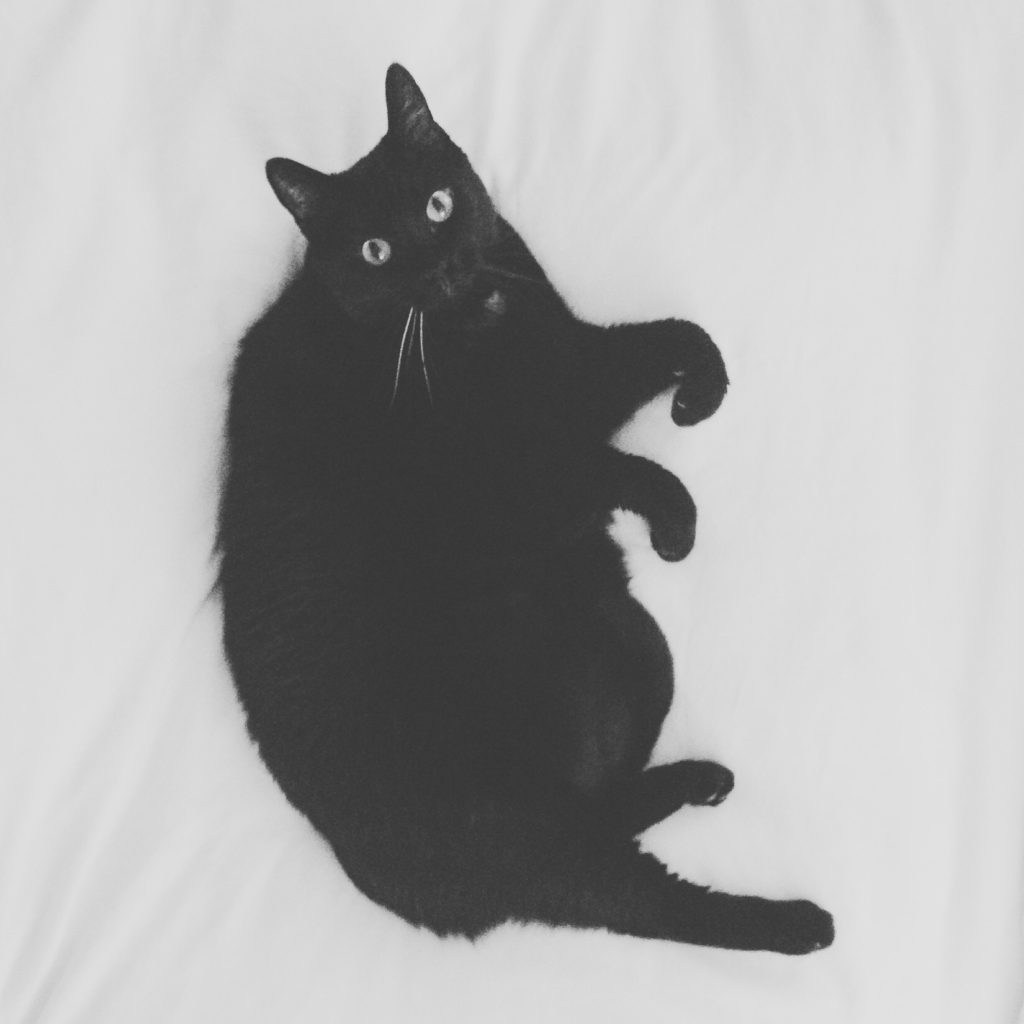
Because the realtor was a silent, uninformative dreg who cared not for the disruption of my domestic ecosystem, he said nothing to my realtor (who was present) about my cat running off. No one knew that Bugs went on this fearful adventure. In fact, it was not until Saturday morning that Bugs’ absence was apparent. I searched the normal hiding spots — behind the bed, in closets and cabinets, and underneath every conceivable object and corner. She had not come out to eat, and if anyone knew Bugs’ temperament, this was abnormal. She is easily about 16 pounds, eats excessively, and uses the litter box more than I can quantify. In the absence of any of these behaviors, it was clear that Bugs was gone.

My search shifted logically to the exterior of the home. I waded through ferns, shrubs, ivy, and everything that surrounded my home. Nothing. This process of searching the same physical areas continued unabated throughout the course of Saturday, that evening, and into Sunday when I was finally informed that the visiting realtor from Friday had allegedly observed Bugs “jump the back fence.” Upon hearing this witness account, I immediately discredited it. Bugs is approximately 15 years old (i.e., geriatric in cat years); she does not jump; she has trouble climbing up my son’s bed at night for support; and, she had never ventured outside the doorframe for longer than a minute.

Equipped with this historical knowledge regarding her tendencies, it was inconceivable that Bugs would have scaled a 7 foot fence and ran up 50 stairs to the mountain. More likely, in my mind, was the fact that she had found a hiding spot nearby at the neighbor’s house and was laying low under a hedge. Nonetheless, I trekked up the stairs and commenced a broader search that would now encompass gnarled cacti, blistering 100 degree heat, poison oak, snake holes, wild bushes, and shrubbery of every conceivable kind.

“This is impossible,” I exclaimed, in a fit of guilt-ridden resignation. If she had traversed up here, the odds of survival would be minimal, at best. There are too many areas, the mountain is expansive, and predators (such as bobcats and coyotes) have been known to frequent the area. Hungrily so.

At that point, I subscribed to the convenient explanation(s) — either that Bugs “was killed by a coyote,” or that she was sick and “wanted to die,” thus resulting in uncharacteristic wandering. Both of these alternatives were suggested by many who heard the story of Bugs’ impromptu escape. To be sure, they were fair and possible conclusions, but they were unsupported by anything concrete. My cat did not appear ill prior to her departure (but for her old age), and I was not willing to import myself into Bugs’ consciousness and presume to conclude that she had executed a dramatic escape in order to die a romantic, alienating death away from the observing eyes of her woebegone owners.

The main factor, though, was that I had invested approximately 15 years into this cat’s life, and Bugs was in a heap of trouble. Unquestionably. So, I cast aside the convenient explanations and the psychological presumptions regarding her rationale for leaving, and I was going to keep looking. Especially now, during what had to be the most critical time. The more time that passed, the prospect of Bugs’ survival in this environment would lessen. This reality hung over me like an anvil.

On Sunday evening, after hours of searching on the mountain above my house, I turned to the Internet for support. I read all of the attendant wisdoms and anecdotes: that indoor cats would invariably be hiding close to home, that I should tap her cat bowl with a fork outside the house, search bushes, and call out to her, and other rather obvious suggestions such as posting signs and informing neighbors. Undaunted, I searched the same areas around my house that evening and found myself morbidly drawn to a stretch of ivy along the side of my house, where an unfortunately rank odor of death was emanating. Of course, my heart sank. This was not a favorable equation. Missing cat + smell of rotting animal flesh = potentially bad result for Bugs. I scoured the ivy with a flashlight leaf by leaf, expecting to find a Bugsy corpse, or some part of her. But I didn’t. Instead, I found the sanctuary of a woodland rat species, nestled in the upper reaches of the ivy, where one had died and was rotting ignominiously. Sickened by this collateral discovery, and certainly resolved to eradicate these pests another day, I was at least thankful that I didn’t locate poor Bugs pushing up the daisies.

Later Sunday evening, I read about Ms. Annalisa Berns of “Pet Search and Rescue,” based out of San Diego. Ms. Berns is a private “pet detective,” who has made it a career to rescue lost pets. Though I thought initially that pet detectives were simply the product of lore or comedy, it was in fact quite real, and Ms. Berns’ devotion to this trade was even more real. After researching her curriculum vitae and discovering that she had been written up in Oprah Winfrey’s “O” Magazine, I decided to reach out to her and get more information. A simple email to her that evening resulted in a swift response, and by 930 p.m., I was in a full-fledged discourse with Annalisa about her services, its cost, and time frames for a potential search. She informed me that she could be at my house by 630 a.m. the following morning. I retained her and decided that locating my terrified, scared kitty was paramount. Plus, if I didn’t at least attempt to retain Annalisa, perhaps I’d feel eternally guilty for not just trying. (Guilt is a real bitch when it comes to losing pets.)

Before retiring for the night, I recalled those mischievous days in my youth when I was intrigued by military gear such as dtnvs, and other seemingly sophisticated search tools. This led me to a specific product, released by the company “Flir”. In plain English, it was basically an optical device enabling an individual to detect heat signatures of animals and humans at a distance of 100 yards during the night. It is called the Flir TK Scout Thermal Monocular. If anyone recalls the film “Predator,” this is similar in terms of the imagery. Looking through a Flir would produce a similar image: that is, a lot of black and undefined areas such as plants, but with all human or animal subjects illuminated in a hot, fiery, reddish hue. Because of my inherently dorky nature, and because it could offer me a potentially useful tool for nighttime searches when it was cooler out, I purchased the Flir TK Scout, and eagerly anticipated its short order delivery by Tuesday, June 28.

Monday mornings in my world are about the vicissitudes of lawyering. I typically wake up with the anxiety of a daunting amount of work, and find that the sanctity of the prior weekend is almost entirely lost within the first few moments in which Monday has suddenly presented herself with an array of responsibilities. Except, on this particular Monday morning, June 27, 2016, there had been no rest. The weekend had been defined by cycles of guilt, tears, impenetrable heat, and a frustrating level of uncertainty over how to locate Bugs. Annalisa arrived at 630am with three search dogs and a set of determined eyes. Her attitude and demeanor were infectious and positive. Only hours after emailing her, she had driven from San Diego and was ready to commence the search. Perhaps Bugs had a chance.

The first order of business was to obtain a scent sample of Bugs’ fur. I listened to Annalisa’s preliminary instructions, which included details about the normal course of a search, staying out of the dogs’ way, the necessity of contacting and advising neighbors of our impending trespasses into their yards, and other protocols. I directed Annalisa to the area behind my bed where Bugs would sleep quite often. As expected, clumps of Bugs’ fur remained in that spot, and within only a matter of seconds, Annalisa had the organic, forensic prompt that she needed to set the search dogs into motion. She gathered the fur into a Ziplock bag and indicated that she could “refresh” the search dog throughout the course of the search by waving it in front of their noses. Only one dog was used at the outset of the search, so as to not taint the others, who remained resting in Annalisa’s truck in a shaded area.

When she presented the dog with the sample fur, the dog darted down the hall. With pinpoint immediacy, the dog traveled to the sliding glass door in the back bedroom and signaled Annalisa to open it. Annalisa opened the door, and the dog proceeded straight to the back fence which led up the flight of fifty stairs. It gave Annalisa the signal. Up. I stood, looking amazed. The dreg idiot realtor was right. Bugs had indeed jumped over the fence and went up the stairs to No Man’s Land. Though excited by the dog’s confirmation of this fact, my heart sank, because I knew what it meant. It meant, specifically, that the search for Bugs was going to necessitate rigorous hiking and searching through the outer edges of the Glendale Hills, where the heat was fierce, and the topography was fiercer.

image1-2

 
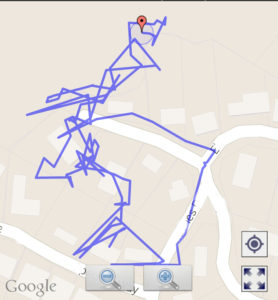
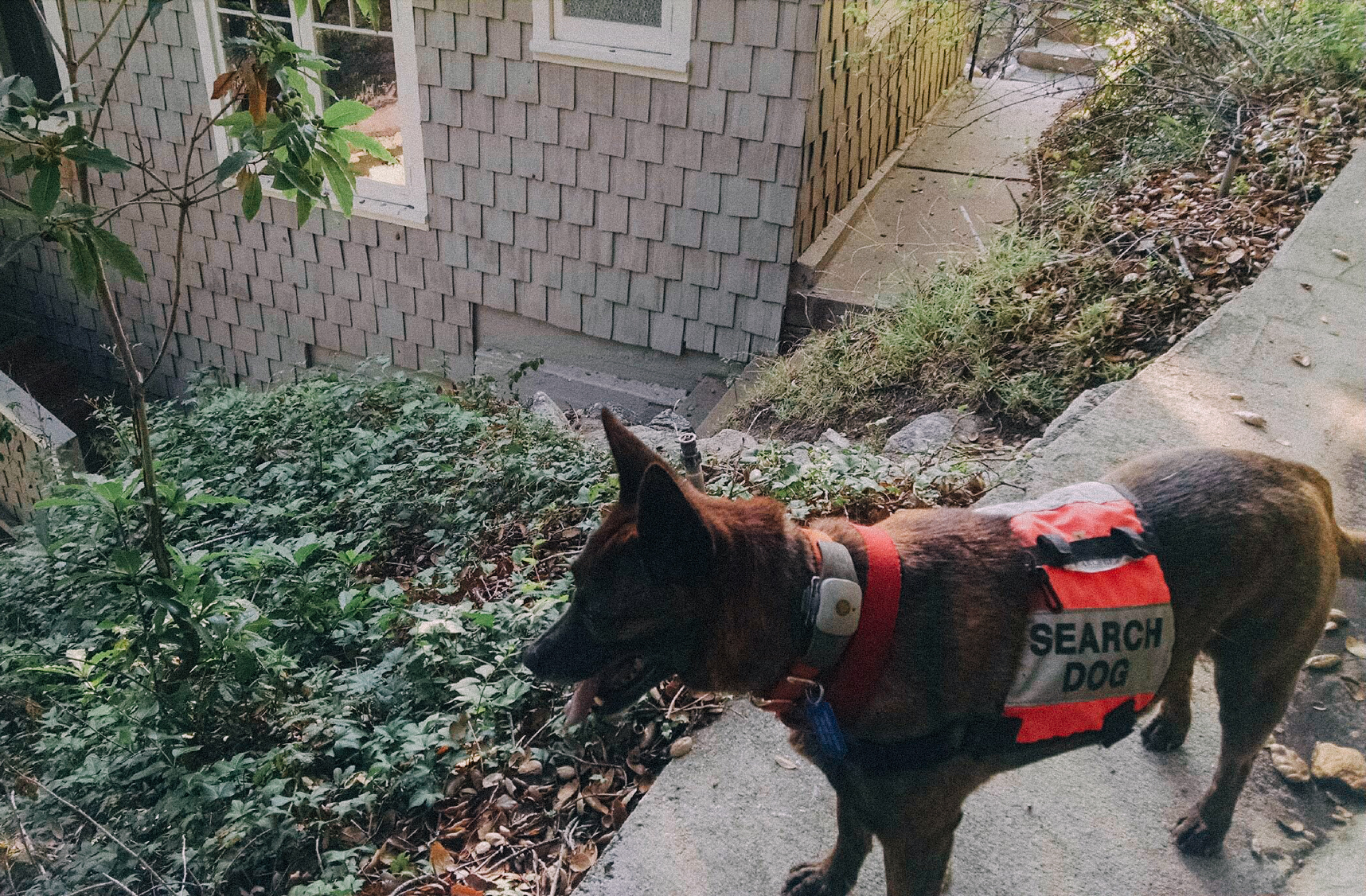
Annalisa instructed me to wait behind so that I would not distract the dog. I stood at the base of the stairs for 45 minutes as she followed the dog through bushes, hills, and other unknown areas. Soon thereafter, Annalisa texted a photograph of the dog (seen above), perched near a neighbor’s home on the other side of the hill. She also texted me a preliminary GPS map, documenting the trajectory of the search dog, which I shall post below. It basically looked like a squiggly line drawn by my 3 year old daughter. Her instruction was to contact the neighbors and indicate that we were searching in the area.

The first neighbor was not home, and the dogs continued their zig-zag path across the hill into other neighbors’ yards, compounding my need to knock on multiple doors. I made my way to the bottom of the street behind my house, and started to contact neighbors. They were generally agreeable with my search efforts, though most seemed perplexed by the notion of a local homeowner enlisting a “search dog” on a Monday morning in order to locate his lost cat. Whatever. The standard response was typically, “the cat is probably gone with so many coyotes in the area.” As such, it was a difficult balance attempting to deflect opinions about my futile efforts, while also informing the neighbors that I was committed to trying and would appreciate cooperation. No one was resistant to our search efforts, and Annalisa continued searching various surroundings without impediment, as reflected in the following image.

image2

It was at this juncture that the neighbor who lived behind me on the hill arrived home. I contacted her and informed her about the search. She introduced herself as Sue. Wearing ankle weights, Sue seemed busied at first, but she soon melted when she realized that we were not solicitors. With her memory jogged, she indicated that she had in fact seen Bugs a day or two prior, attempting to get into her back door. She described the exact physical characteristics of Bugs, along with her unmistakable green eyes, and informed us that Bugs had been cowering in fear. (Cue crestfallen reaction and biting tears.)

This would prove to be the best clue regarding Bugs’ physical whereabouts. Annalisa used all three search dogs throughout the course of the morning, and they independently and uniformly identified a similar circumference of physical territory where Bugs’ scent had been left. The home where Sue saw the cat was at the dead center of this target area.

Though Annalisa’s hopes were high, the circumference of potential search areas, coupled with the fact that one of the dogs sniffed her way up a nearby fire access road along a distant mountain, left me with a sense of impending dread. Not to be discouraged, Annalisa informed me that this was a discrete area and to remain steadfast in my efforts, because the dogs did not indicate to her that there was a scent of death. To that end, Annalisa encouraged that I put up signs and distribute fliers. Most importantly, she advised me to continue walking along these same paths and regions, in order to leave a trail of my scent, so that Bugs – if still alive and hiding in the area – would perhaps detect my scent and be able to navigate herself back home. Monday’s search with Annalisa concluded just before 11 a.m., when the heat had already reached a deadening mark of approximately 95 degrees. The dogs were tired, and my spirits were shrunk. After kindly receiving some poster boards and a huge Sharpie marker from Annalisa, I drafted several large signs and taped them around light poles in the neighborhood. “LOST CAT, PLEASE CALL.”

Though I went to work after Annalisa’s departure, my thoughts were never far from Bugs. I empathized with her plight. I envisioned her buried and ensnared in a thicket of dense hot brush, up along a mountain, meowing and wondering how to get home. Every second that I sat at my desk, I felt an augmenting sense of responsibility in my guts to continue searching. To not give up.

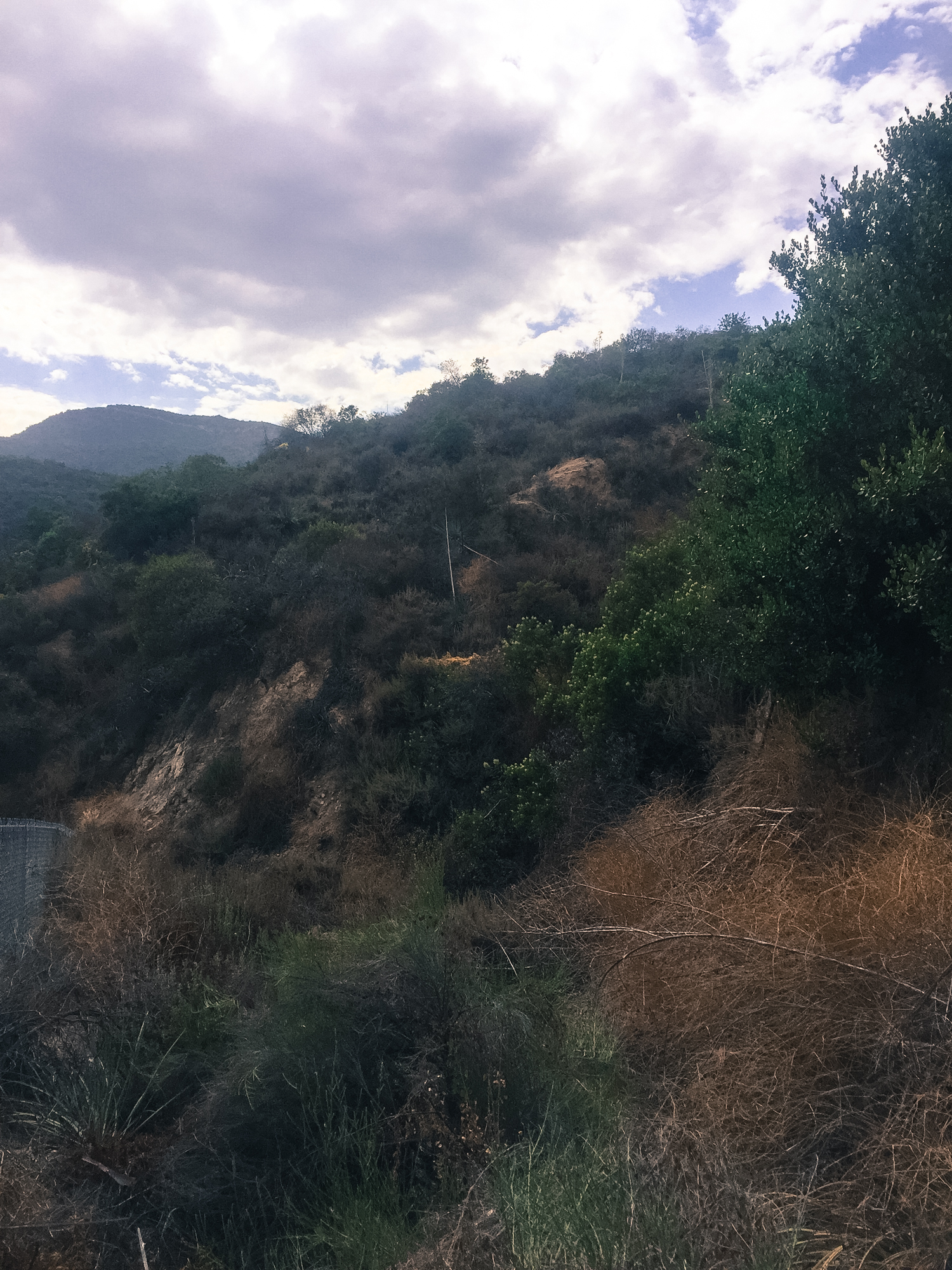
Yet, Monday night’s search was fruitless. I scoured the mountain along with all of the points of interest noted by the search dogs. Nothing. By Tuesday morning, my spirits had dwindled to desolation, and I felt resigned to the possibility that I had to learn to let go. Nonetheless, I went for a walk early in the morning, and re-traced all steps up my hills, down along the street behind my house, and into a storm drain wash that exists at the end of a cul de sac, where there are no homes, and instead the expanses and wooded areas of the hills.

image3-2

 
By Tuesday afternoon, my Flir TK scout thermal monocular had arrived in the mail. If anything, I felt a moderately renewed sense of hope that I could at least use this tool to locate her during the nighttime hours. I got home early from work and distributed 100 fliers to local residents, which offered a short narrative about Bugs, a couple of photos, and the promise of a reward. I felt extremely puny and defeated when certain residents were outside of their homes at the time of my distribution, and they assumed I was a solicitor. I informed them of my lost cat, and that I was searching. Most people simply offered condolences, knowing that the area was intricate and impossibly treacherous. Furthermore, the heat was blistering, my energy reserves were depleted (i.e., I looked like death, or death’s cousin), and I was developing a sore throat. That night, after a brief rest, I ascended my steps and began learning the intricacies of the Flir TK Scout. I scrolled through its various settings, viewing the nighttime terrain in a variety of colors and heat sensitivities. It was all extraordinarily interesting from a technical standpoint. But, it was completely uninteresting emotionally. Cool gear; no Bugs.

Wednesday arrived, and with it was a sense of diminishing resolve. I knew I could not continue searching at this pace. It was unsustainable. Nonetheless, I returned home from work and hiked along the hills for 2 hours, to a further extent than before. I hiked up a fire access road through thickets of dangerous brush, peering down into neighbors’ back yards, attempting to avoid perilous patches of poison oak.

On my way home, I stopped uncharacteristically atop the hill in back of my house and sat in a chair. A chair had been left there by a neighbor for bird watching purposes, and/or other voyeuristic viewing pleasures. I never sat there before. It was really quite pretty though, and the birds were sonorous. I had always ignored those dirty chairs, never electing to absorb and listen to the environment. Though sitting there was peaceful, I became morbidly sad. All of this goddamn effort was sinking in. For what? I felt that I had let Bugs down, though I knew consciously that I was putting in more effort than anyone could have anticipated.

For some reason, that night, after putting the kids to sleep, I thought I would go out one more time with the thermal monocular. What the hell. I paid for the damn thing, and paid for a search dog to give me a target area, so why not go again? To give myself a chance. To give Bugs a chance. To increase my frequency in the area and to increase at least the chance of seeing something. I took my backpack, a flashlight, and the monocular and headed up the hill. After searching through the leaves and the cactus very slowly, I approached Sue’s home at the top of the hill. I stopped. I sighed. I looked down along a series of landscaped rocky steps, and there was Bugs. Laying there. Meowing.

Holy Bugs!

I didn’t know what to do. I approached her slowly, and she darted off. She was out of sight. I contacted Sue immediately, asking if I could poke around throughout the backyard, as I had just spotted Bugs. I was frustrated, but exhilarated. She granted me carte blanche, and the search was on. Thinking that Bugs was in a starved and frightened state, I wanted to get something to bait her. My mind was racing. So, I gambled and decided to leave the area to retrieve Bugs’ cat bowl and get some food. It would take approximately 5 minutes to retrieve it, but I figured that she was now at least somewhat confined to a certain geographical area and would be within earshot when I returned. Hell, maybe she had been there the entire time for 5 days. Who knows. But, I saw her. Let’s roll with it.

I returned with the feeding bowl and used the thermal monocular to try and locate her position. I couldn’t locate her, but instead, I managed to see her glowing set of green eyes when I used my flashlight in a new direction. She was 15 feet away on the other side of Sue’s back patio. This is good. I moved slow and attempted to bait her with the bowl, but unfortunately, she darted off once again.

I pulled out the monocular and located her 25 yards away, hunkered down in a thicket of weeds. I sighed, and realized I was dealing effectively with a new and different animal. It was Bugs, to be sure, but it was the wild, scared and feral version of my little companion. As a result, I decided that I would engage in a prolonged stand-off, in an effort to have her remain as calm as possible.

I sat on the ground and spoke to her in soft, calming tones. “Hey, Bugs, how ya doin?” I whistled and sat in the dirt, not really seeming eager. Yet, I inched forward at a snail’s pace, constantly rattling the bowl, ensuring that she would not get freaked out and dart off again. This incremental process continued for 40 minutes until I got within an arm’s length of her. Though I wanted to leap at her, I figured I would just keep it calm. She was terrified and looking left and right for potential dangers, but I kept her focused on the bowl and my voice. Once I could reach my hand out slowly, she smelled my hand, and her defensiveness immediately vanished. She walked straight into my arms.

I grabbed Bugs and clenched her as comprehensively and strongly as possible. Leaving all of my gear on the ground, I walked her across the crest of the hill, down 50 steps, and back to the house, kissing her the entire way.

It was five days of searching in deadening heat and adverse conditions. Five days of vacillating emotions. Five days of the unknown. Five days of weird justifications and thoughts. They say a cat has nine lives, and that cats often display curious behavior. It is so true. But what is rarely discussed is the owner’s response to a pet’s dilemma. What to do, how to do it, and in some cases, whether to do it at all. I submit that animals are family. This should not come as some groundbreaking observation. They are part of the peaceful, environmental fabric that you have cultivated in your home. To abandon your animal with immediacy and with resort to convenient psychological presumptions about their intent is to abandon your commitment to the love and affection that you both have forged. I could never blame anyone for doing even 1/10th of what I chose to do. Everyone has different issues, time commitments, pressures, limitations, and levels of resolve. But I can faithfully report that love and determination, in its rawest form, can produce beautiful results.

This was Bugsy’s Great Adventure, and I am ecstatic to see that she is purring next to my son at night, assured on some innate level, that she is loved.

Processed with VSCOcam with b1 preset