Categories
Music

Fake News

As a legal practitioner and someone who cares a great deal about humanity, I find it particularly intolerable to watch the events that are unfolding in the White House. Typically, I reserve political opinions to myself, as it remains a steadfast and well-established truth that political and religious discussions often lead to strife and consternation. That is a personally held belief frankly, not necessarily any kind of entreaty or justification for others to remain silent in the wake of stupidity and intellectual dishonesty.

Among the multitude of alarming issues that are emerging in politics, I find that the credibility of our President is a disaster. Utilizing the very standard of criticism and evaluation that he utilized on the campaign trail (i.e., when disparaging Hillary Clinton and others), it would seem undisputed that President Trump’s presidency is a disaster. I am tired of the flippant, reckless, and unfiltered comments that he makes — often times, ones that are totally unsubstantiated and which can be refuted without much intellectual effort.

This is where my experience as an attorney is brought to bear. I spend my days defending the very hard working people employed by municipalities, school districts, and police departments, and often times, I am called upon to defend them from meritless and specious lawsuits. In that capacity, it is my job to demonstrate inconsistency in legal arguments and to refute contentions that lack merit. As a result, when I hear our President make sweeping generalizations, it seems preposterous to me that the political community (and his voters) remain — in any way — supportive of him. That the GOP has endorsed him as a matter of convenience and have abandoned their own sense of conviction is equally disconcerting.

It seems to me that the “fake news” that exists in the modern media is that which is being spouted by the President himself. And, thus, in the President’s egomaniacal efforts to disparage the free press, he is only deflecting attention from his own prevarications. Currying favor with a mob mentality of misdirection. If this were a court of law, I would impeach his credibility on the witness stand with more ammunition than I know what to do with.

This is going to be a long 4 years. I need to take more photographs. <3.

Categories
Pets Photography

Bugsy’s Great Adventure

Pet ownership is a curious thing. It expands our notions of companionship and broadens our capacity to love. It allows us to perceive and experience devotion without the complexity of human discourse. It is a relationship devoid of machination, and one that symbolizes the beauty of affiliation between two creatures. A beauty that is simple, organic, and pure.

So, when you lose a pet, as I did in this particular case, the question became: what is the extent of my devotion? A devotion perhaps not just to the individual pet, but to the inherent concept of pet ownership itself. To me, losing my cat presented a larger question regarding what an owner can and should do, rationally, in the face of frustrating adversity. I suppose for me, the answer was obvious, even if it involved an untenable level of effort. After years of providing a nurturing sanctuary for my cat, changing litter boxes, and cracking open cans of food on a daily basis, I had to ask myself: what exactly was the limit of my effort to search for my cat when she was lost, scared, and in need of my help?

The story begins somewhat simply, if not frustratingly, with an instance of contemptible behavior. I lost Bugs on Friday evening, June 24, 2016. During the course of our attempt to sell our home, we had a private showing scheduled for 4pm that afternoon. A realtor and his clients were to arrive and take a look at our home. It was at this fateful hour that the realtor and his group of guests opened a large sliding glass door in a back bedroom, and Bugs — most likely flanked on both sides by unknown, loud, and generally aloof interlopers — fled through the open door and allegedly “hopped a fence” in my backyard, ascending a flight of fifty (50) stairs to a wilderness replete with cactus, oak trees, brush, sage, and predators of various orders.

Because the realtor was a silent, uninformative dreg who cared not for the disruption of my domestic ecosystem, he said nothing to my realtor (who was present) about my cat running off. No one knew that Bugs went on this fearful adventure. In fact, it was not until Saturday morning that Bugs’ absence was apparent. I searched the normal hiding spots — behind the bed, in closets and cabinets, and underneath every conceivable object and corner. She had not come out to eat, and if anyone knew Bugs’ temperament, this was abnormal. She is easily about 16 pounds, eats excessively, and uses the litter box more than I can quantify. In the absence of any of these behaviors, it was clear that Bugs was gone.

My search shifted logically to the exterior of the home. I waded through ferns, shrubs, ivy, and everything that surrounded my home. Nothing. This process of searching the same physical areas continued unabated throughout the course of Saturday, that evening, and into Sunday when I was finally informed that the visiting realtor from Friday had allegedly observed Bugs “jump the back fence.” Upon hearing this witness account, I immediately discredited it. Bugs is approximately 15 years old (i.e., geriatric in cat years); she does not jump; she has trouble climbing up my son’s bed at night for support; and, she had never ventured outside the doorframe for longer than a minute.

Equipped with this historical knowledge regarding her tendencies, it was inconceivable that Bugs would have scaled a 7 foot fence and ran up 50 stairs to the mountain. More likely, in my mind, was the fact that she had found a hiding spot nearby at the neighbor’s house and was laying low under a hedge. Nonetheless, I trekked up the stairs and commenced a broader search that would now encompass gnarled cacti, blistering 100 degree heat, poison oak, snake holes, wild bushes, and shrubbery of every conceivable kind.

“This is impossible,” I exclaimed, in a fit of guilt-ridden resignation. If she had traversed up here, the odds of survival would be minimal, at best. There are too many areas, the mountain is expansive, and predators (such as bobcats and coyotes) have been known to frequent the area. Hungrily so.

At that point, I subscribed to the convenient explanation(s) — either that Bugs “was killed by a coyote,” or that she was sick and “wanted to die,” thus resulting in uncharacteristic wandering. Both of these alternatives were suggested by many who heard the story of Bugs’ impromptu escape. To be sure, they were fair and possible conclusions, but they were unsupported by anything concrete. My cat did not appear ill prior to her departure (but for her old age), and I was not willing to import myself into Bugs’ consciousness and presume to conclude that she had executed a dramatic escape in order to die a romantic, alienating death away from the observing eyes of her woebegone owners.

The main factor, though, was that I had invested approximately 15 years into this cat’s life, and Bugs was in a heap of trouble. Unquestionably. So, I cast aside the convenient explanations and the psychological presumptions regarding her rationale for leaving, and I was going to keep looking. Especially now, during what had to be the most critical time. The more time that passed, the prospect of Bugs’ survival in this environment would lessen. This reality hung over me like an anvil.

On Sunday evening, after hours of searching on the mountain above my house, I turned to the Internet for support. I read all of the attendant wisdoms and anecdotes: that indoor cats would invariably be hiding close to home, that I should tap her cat bowl with a fork outside the house, search bushes, and call out to her, and other rather obvious suggestions such as posting signs and informing neighbors. Undaunted, I searched the same areas around my house that evening and found myself morbidly drawn to a stretch of ivy along the side of my house, where an unfortunately rank odor of death was emanating. Of course, my heart sank. This was not a favorable equation. Missing cat + smell of rotting animal flesh = potentially bad result for Bugs. I scoured the ivy with a flashlight leaf by leaf, expecting to find a Bugsy corpse, or some part of her. But I didn’t. Instead, I found the sanctuary of a woodland rat species, nestled in the upper reaches of the ivy, where one had died and was rotting ignominiously. Sickened by this collateral discovery, and certainly resolved to eradicate these pests another day, I was at least thankful that I didn’t locate poor Bugs pushing up the daisies.

Later Sunday evening, I read about Ms. Annalisa Berns of “Pet Search and Rescue,” based out of San Diego. Ms. Berns is a private “pet detective,” who has made it a career to rescue lost pets. Though I thought initially that pet detectives were simply the product of lore or comedy, it was in fact quite real, and Ms. Berns’ devotion to this trade was even more real. After researching her curriculum vitae and discovering that she had been written up in Oprah Winfrey’s “O” Magazine, I decided to reach out to her and get more information. A simple email to her that evening resulted in a swift response, and by 930 p.m., I was in a full-fledged discourse with Annalisa about her services, its cost, and time frames for a potential search. She informed me that she could be at my house by 630 a.m. the following morning. I retained her and decided that locating my terrified, scared kitty was paramount. Plus, if I didn’t at least attempt to retain Annalisa, perhaps I’d feel eternally guilty for not just trying. (Guilt is a real bitch when it comes to losing pets.)

Before retiring for the night, I recalled those mischievous days in my youth when I was intrigued by military gear such as dtnvs, and other seemingly sophisticated search tools. This led me to a specific product, released by the company “Flir”. In plain English, it was basically an optical device enabling an individual to detect heat signatures of animals and humans at a distance of 100 yards during the night. It is called the Flir TK Scout Thermal Monocular. If anyone recalls the film “Predator,” this is similar in terms of the imagery. Looking through a Flir would produce a similar image: that is, a lot of black and undefined areas such as plants, but with all human or animal subjects illuminated in a hot, fiery, reddish hue. Because of my inherently dorky nature, and because it could offer me a potentially useful tool for nighttime searches when it was cooler out, I purchased the Flir TK Scout, and eagerly anticipated its short order delivery by Tuesday, June 28.

Monday mornings in my world are about the vicissitudes of lawyering. I typically wake up with the anxiety of a daunting amount of work, and find that the sanctity of the prior weekend is almost entirely lost within the first few moments in which Monday has suddenly presented herself with an array of responsibilities. Except, on this particular Monday morning, June 27, 2016, there had been no rest. The weekend had been defined by cycles of guilt, tears, impenetrable heat, and a frustrating level of uncertainty over how to locate Bugs. Annalisa arrived at 630am with three search dogs and a set of determined eyes. Her attitude and demeanor were infectious and positive. Only hours after emailing her, she had driven from San Diego and was ready to commence the search. Perhaps Bugs had a chance.

The first order of business was to obtain a scent sample of Bugs’ fur. I listened to Annalisa’s preliminary instructions, which included details about the normal course of a search, staying out of the dogs’ way, the necessity of contacting and advising neighbors of our impending trespasses into their yards, and other protocols. I directed Annalisa to the area behind my bed where Bugs would sleep quite often. As expected, clumps of Bugs’ fur remained in that spot, and within only a matter of seconds, Annalisa had the organic, forensic prompt that she needed to set the search dogs into motion. She gathered the fur into a Ziplock bag and indicated that she could “refresh” the search dog throughout the course of the search by waving it in front of their noses. Only one dog was used at the outset of the search, so as to not taint the others, who remained resting in Annalisa’s truck in a shaded area.

When she presented the dog with the sample fur, the dog darted down the hall. With pinpoint immediacy, the dog traveled to the sliding glass door in the back bedroom and signaled Annalisa to open it. Annalisa opened the door, and the dog proceeded straight to the back fence which led up the flight of fifty stairs. It gave Annalisa the signal. Up. I stood, looking amazed. The dreg idiot realtor was right. Bugs had indeed jumped over the fence and went up the stairs to No Man’s Land. Though excited by the dog’s confirmation of this fact, my heart sank, because I knew what it meant. It meant, specifically, that the search for Bugs was going to necessitate rigorous hiking and searching through the outer edges of the Glendale Hills, where the heat was fierce, and the topography was fiercer.

image1-2

 
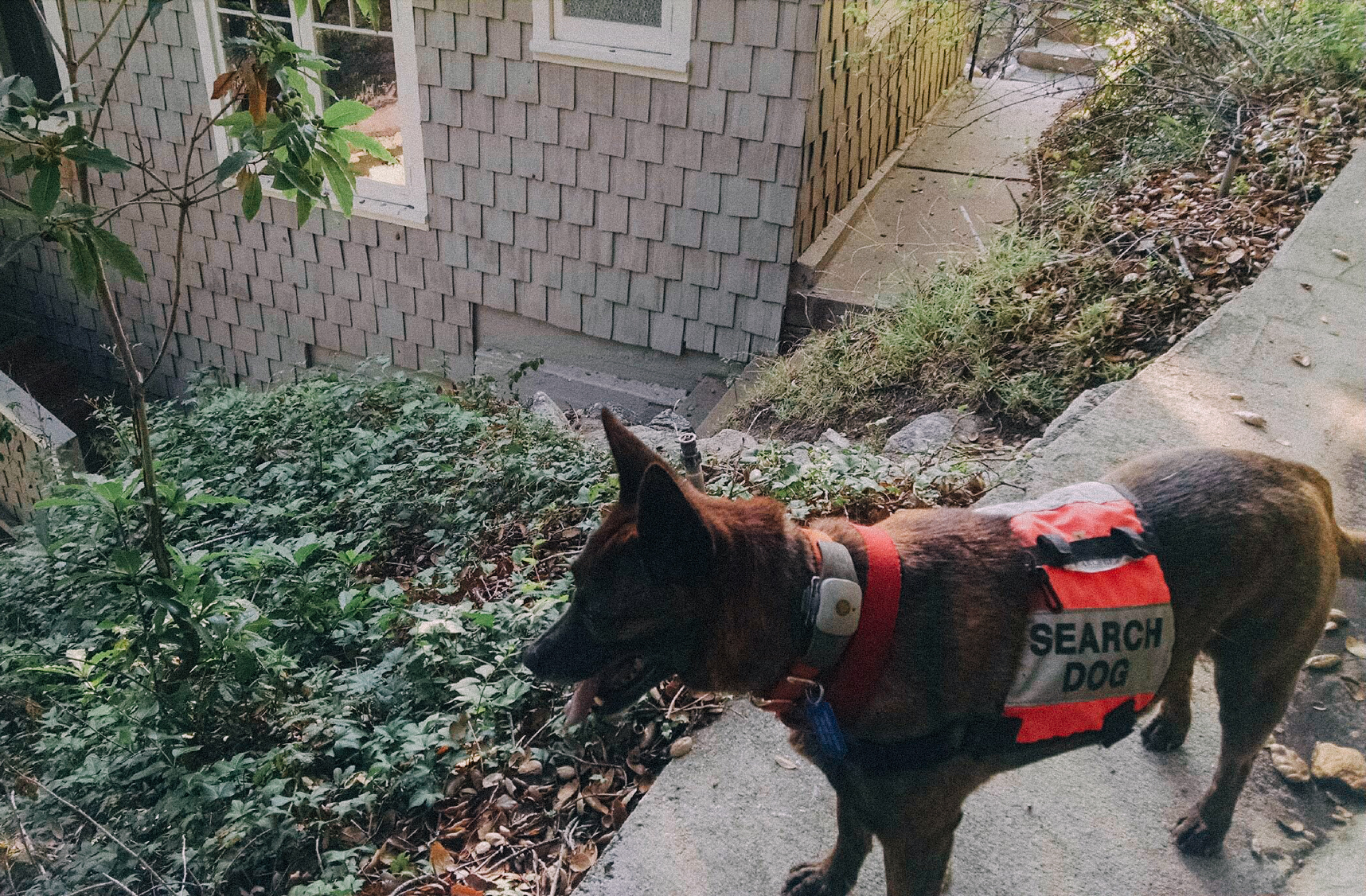
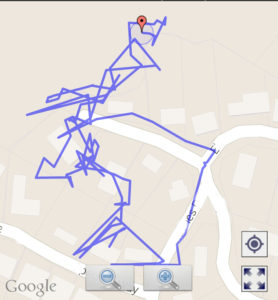
Annalisa instructed me to wait behind so that I would not distract the dog. I stood at the base of the stairs for 45 minutes as she followed the dog through bushes, hills, and other unknown areas. Soon thereafter, Annalisa texted a photograph of the dog (seen above), perched near a neighbor’s home on the other side of the hill. She also texted me a preliminary GPS map, documenting the trajectory of the search dog, which I shall post below. It basically looked like a squiggly line drawn by my 3 year old daughter. Her instruction was to contact the neighbors and indicate that we were searching in the area.

The first neighbor was not home, and the dogs continued their zig-zag path across the hill into other neighbors’ yards, compounding my need to knock on multiple doors. I made my way to the bottom of the street behind my house, and started to contact neighbors. They were generally agreeable with my search efforts, though most seemed perplexed by the notion of a local homeowner enlisting a “search dog” on a Monday morning in order to locate his lost cat. Whatever. The standard response was typically, “the cat is probably gone with so many coyotes in the area.” As such, it was a difficult balance attempting to deflect opinions about my futile efforts, while also informing the neighbors that I was committed to trying and would appreciate cooperation. No one was resistant to our search efforts, and Annalisa continued searching various surroundings without impediment, as reflected in the following image.

image2

It was at this juncture that the neighbor who lived behind me on the hill arrived home. I contacted her and informed her about the search. She introduced herself as Sue. Wearing ankle weights, Sue seemed busied at first, but she soon melted when she realized that we were not solicitors. With her memory jogged, she indicated that she had in fact seen Bugs a day or two prior, attempting to get into her back door. She described the exact physical characteristics of Bugs, along with her unmistakable green eyes, and informed us that Bugs had been cowering in fear. (Cue crestfallen reaction and biting tears.)

This would prove to be the best clue regarding Bugs’ physical whereabouts. Annalisa used all three search dogs throughout the course of the morning, and they independently and uniformly identified a similar circumference of physical territory where Bugs’ scent had been left. The home where Sue saw the cat was at the dead center of this target area.

Though Annalisa’s hopes were high, the circumference of potential search areas, coupled with the fact that one of the dogs sniffed her way up a nearby fire access road along a distant mountain, left me with a sense of impending dread. Not to be discouraged, Annalisa informed me that this was a discrete area and to remain steadfast in my efforts, because the dogs did not indicate to her that there was a scent of death. To that end, Annalisa encouraged that I put up signs and distribute fliers. Most importantly, she advised me to continue walking along these same paths and regions, in order to leave a trail of my scent, so that Bugs – if still alive and hiding in the area – would perhaps detect my scent and be able to navigate herself back home. Monday’s search with Annalisa concluded just before 11 a.m., when the heat had already reached a deadening mark of approximately 95 degrees. The dogs were tired, and my spirits were shrunk. After kindly receiving some poster boards and a huge Sharpie marker from Annalisa, I drafted several large signs and taped them around light poles in the neighborhood. “LOST CAT, PLEASE CALL.”

Though I went to work after Annalisa’s departure, my thoughts were never far from Bugs. I empathized with her plight. I envisioned her buried and ensnared in a thicket of dense hot brush, up along a mountain, meowing and wondering how to get home. Every second that I sat at my desk, I felt an augmenting sense of responsibility in my guts to continue searching. To not give up.

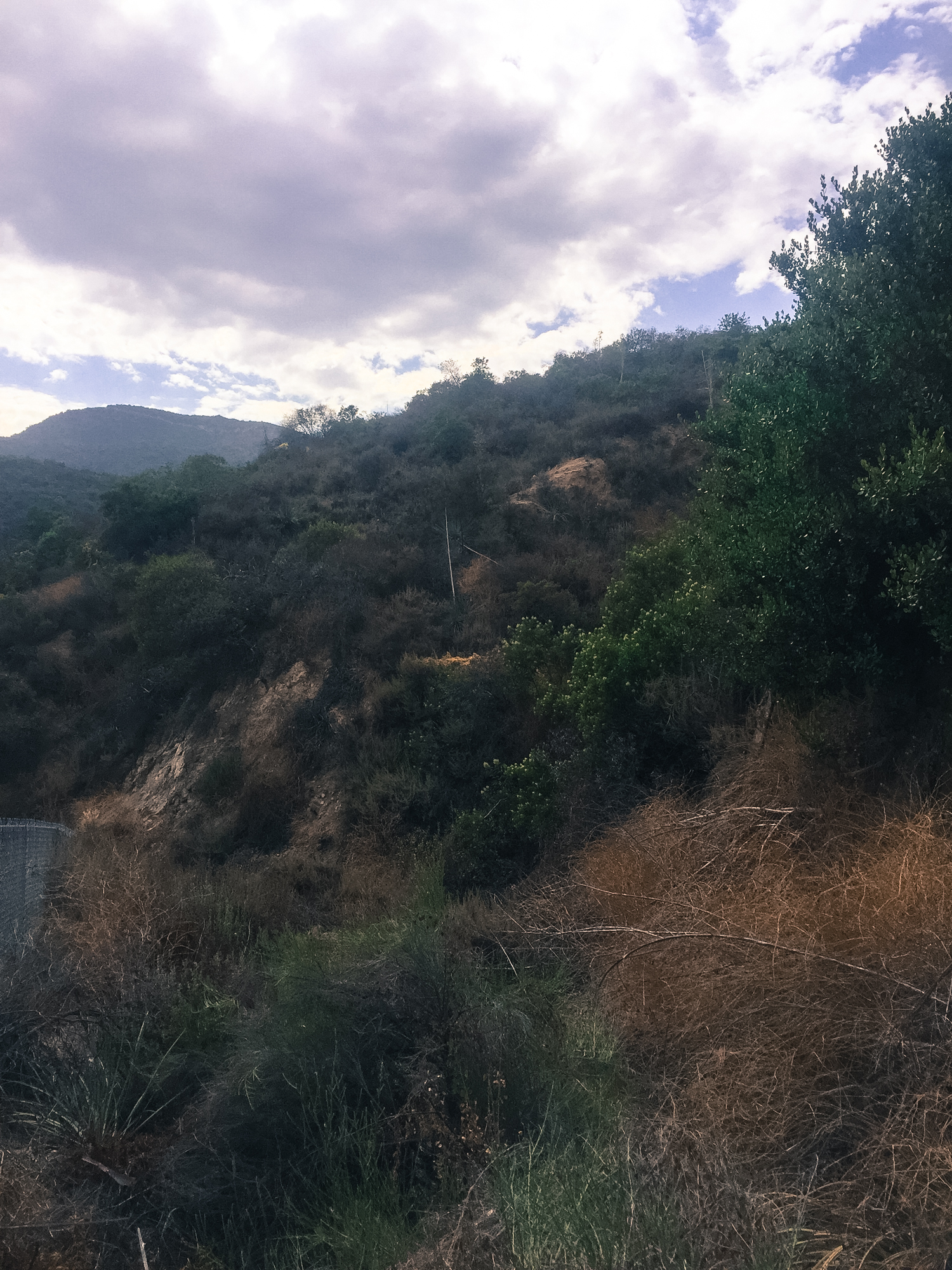
Yet, Monday night’s search was fruitless. I scoured the mountain along with all of the points of interest noted by the search dogs. Nothing. By Tuesday morning, my spirits had dwindled to desolation, and I felt resigned to the possibility that I had to learn to let go. Nonetheless, I went for a walk early in the morning, and re-traced all steps up my hills, down along the street behind my house, and into a storm drain wash that exists at the end of a cul de sac, where there are no homes, and instead the expanses and wooded areas of the hills.

image3-2

 
By Tuesday afternoon, my Flir TK scout thermal monocular had arrived in the mail. If anything, I felt a moderately renewed sense of hope that I could at least use this tool to locate her during the nighttime hours. I got home early from work and distributed 100 fliers to local residents, which offered a short narrative about Bugs, a couple of photos, and the promise of a reward. I felt extremely puny and defeated when certain residents were outside of their homes at the time of my distribution, and they assumed I was a solicitor. I informed them of my lost cat, and that I was searching. Most people simply offered condolences, knowing that the area was intricate and impossibly treacherous. Furthermore, the heat was blistering, my energy reserves were depleted (i.e., I looked like death, or death’s cousin), and I was developing a sore throat. That night, after a brief rest, I ascended my steps and began learning the intricacies of the Flir TK Scout. I scrolled through its various settings, viewing the nighttime terrain in a variety of colors and heat sensitivities. It was all extraordinarily interesting from a technical standpoint. But, it was completely uninteresting emotionally. Cool gear; no Bugs.

Wednesday arrived, and with it was a sense of diminishing resolve. I knew I could not continue searching at this pace. It was unsustainable. Nonetheless, I returned home from work and hiked along the hills for 2 hours, to a further extent than before. I hiked up a fire access road through thickets of dangerous brush, peering down into neighbors’ back yards, attempting to avoid perilous patches of poison oak.

On my way home, I stopped uncharacteristically atop the hill in back of my house and sat in a chair. A chair had been left there by a neighbor for bird watching purposes, and/or other voyeuristic viewing pleasures. I never sat there before. It was really quite pretty though, and the birds were sonorous. I had always ignored those dirty chairs, never electing to absorb and listen to the environment. Though sitting there was peaceful, I became morbidly sad. All of this goddamn effort was sinking in. For what? I felt that I had let Bugs down, though I knew consciously that I was putting in more effort than anyone could have anticipated.

For some reason, that night, after putting the kids to sleep, I thought I would go out one more time with the thermal monocular. What the hell. I paid for the damn thing, and paid for a search dog to give me a target area, so why not go again? To give myself a chance. To give Bugs a chance. To increase my frequency in the area and to increase at least the chance of seeing something. I took my backpack, a flashlight, and the monocular and headed up the hill. After searching through the leaves and the cactus very slowly, I approached Sue’s home at the top of the hill. I stopped. I sighed. I looked down along a series of landscaped rocky steps, and there was Bugs. Laying there. Meowing.

Holy Bugs!

I didn’t know what to do. I approached her slowly, and she darted off. She was out of sight. I contacted Sue immediately, asking if I could poke around throughout the backyard, as I had just spotted Bugs. I was frustrated, but exhilarated. She granted me carte blanche, and the search was on. Thinking that Bugs was in a starved and frightened state, I wanted to get something to bait her. My mind was racing. So, I gambled and decided to leave the area to retrieve Bugs’ cat bowl and get some food. It would take approximately 5 minutes to retrieve it, but I figured that she was now at least somewhat confined to a certain geographical area and would be within earshot when I returned. Hell, maybe she had been there the entire time for 5 days. Who knows. But, I saw her. Let’s roll with it.

I returned with the feeding bowl and used the thermal monocular to try and locate her position. I couldn’t locate her, but instead, I managed to see her glowing set of green eyes when I used my flashlight in a new direction. She was 15 feet away on the other side of Sue’s back patio. This is good. I moved slow and attempted to bait her with the bowl, but unfortunately, she darted off once again.

I pulled out the monocular and located her 25 yards away, hunkered down in a thicket of weeds. I sighed, and realized I was dealing effectively with a new and different animal. It was Bugs, to be sure, but it was the wild, scared and feral version of my little companion. As a result, I decided that I would engage in a prolonged stand-off, in an effort to have her remain as calm as possible.

I sat on the ground and spoke to her in soft, calming tones. “Hey, Bugs, how ya doin?” I whistled and sat in the dirt, not really seeming eager. Yet, I inched forward at a snail’s pace, constantly rattling the bowl, ensuring that she would not get freaked out and dart off again. This incremental process continued for 40 minutes until I got within an arm’s length of her. Though I wanted to leap at her, I figured I would just keep it calm. She was terrified and looking left and right for potential dangers, but I kept her focused on the bowl and my voice. Once I could reach my hand out slowly, she smelled my hand, and her defensiveness immediately vanished. She walked straight into my arms.

I grabbed Bugs and clenched her as comprehensively and strongly as possible. Leaving all of my gear on the ground, I walked her across the crest of the hill, down 50 steps, and back to the house, kissing her the entire way.

It was five days of searching in deadening heat and adverse conditions. Five days of vacillating emotions. Five days of the unknown. Five days of weird justifications and thoughts. They say a cat has nine lives, and that cats often display curious behavior. It is so true. But what is rarely discussed is the owner’s response to a pet’s dilemma. What to do, how to do it, and in some cases, whether to do it at all. I submit that animals are family. This should not come as some groundbreaking observation. They are part of the peaceful, environmental fabric that you have cultivated in your home. To abandon your animal with immediacy and with resort to convenient psychological presumptions about their intent is to abandon your commitment to the love and affection that you both have forged. I could never blame anyone for doing even 1/10th of what I chose to do. Everyone has different issues, time commitments, pressures, limitations, and levels of resolve. But I can faithfully report that love and determination, in its rawest form, can produce beautiful results.

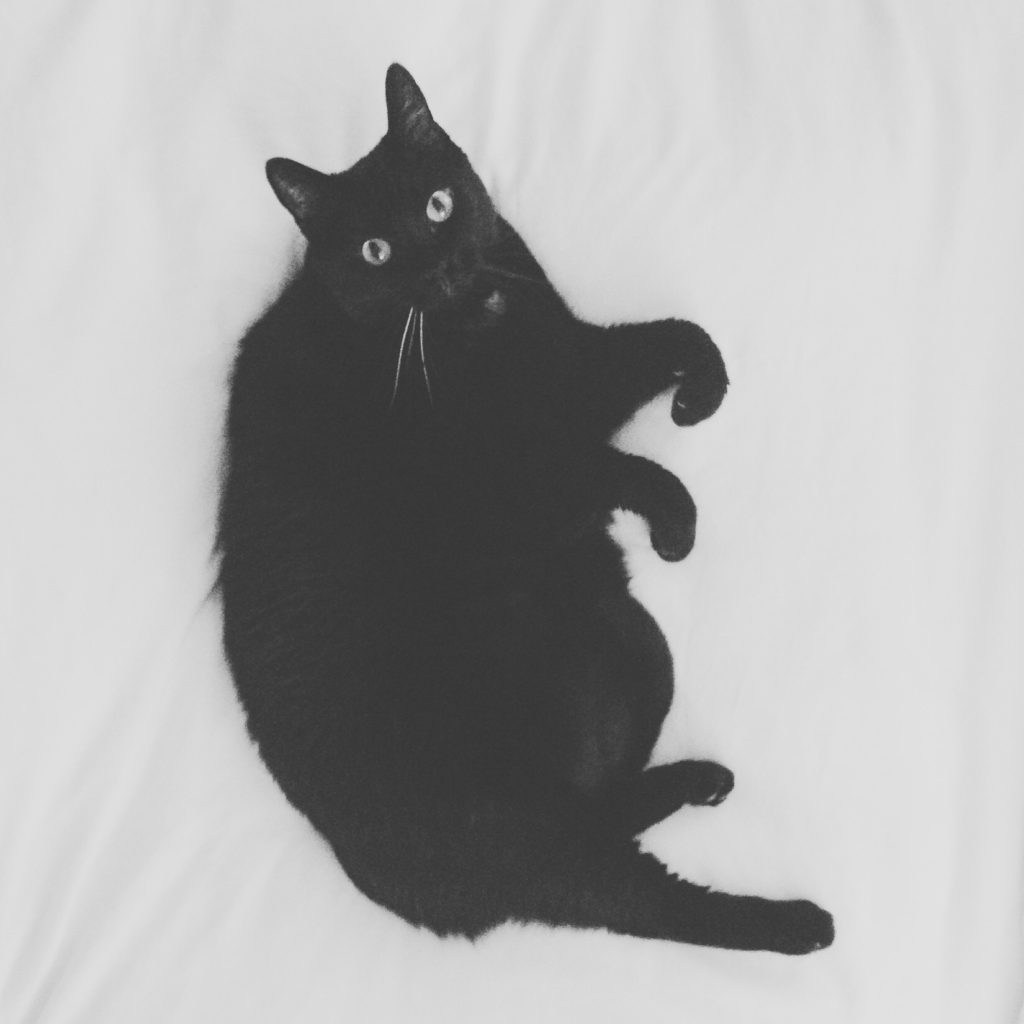
This was Bugsy’s Great Adventure, and I am ecstatic to see that she is purring next to my son at night, assured on some innate level, that she is loved.

Processed with VSCOcam with b1 preset

Categories
The Laureate

The Laureate: Chapter 1

The oppressive rains were like a sweet poison. Hard and unrelenting. In his dream, William Redgrave was submerged in a dark sea of forest trees, eager to find release. His hands were pinned by heavy metallic generators, his legs severed, and above him, father was poised with the bloodied axe in hand. William awoke with a start. Fire-flushed cheeks. He was lying prostrate on the cold, wooden floor, amidst a phalanx of scientific beakers. His eyes suddenly revealed his position beneath a window that opened to the sea—a window that had been firmly closed when he retired.

He knew it would happen like this. The dreariness was all too familiar. It was nearly dawn, and as he peered through the darkness, he observed that his bedchamber was in shambles, as if some violent struggle had occurred—with chairs overturned, blankets thrown off the bed, and his nightclothes ripped apart as if destroyed by an ambient creature. Hundreds of loose pages were scattered across the dusty floor.

“Please God,” he thought in a panic, “not again.”

He lit a candle and inspected the pages, but this time, it was even worse than he had feared. The fiery sheets were filled with scribbled notes, arcane symbols, and strangely disturbing images. Horrified, William gathered the pages into his trembling hands and crumpled them, ripping the demonic words apart, and throwing his verse angrily into the fireplace like a wild savage. Perhaps by destroying them, he could be free from this.

William leaned against the warm mantelpiece, watching as the sheets disintegrated into heaps of cinders. A billowing cloud of dust and ash rose to the ceiling, and although he wished desperately to move away, his legs were heavy and numb. He followed the dissipating trail of smoke upwards into the air, and through the seemingly impenetrable haze. As if mesmerized by the seeds of his own destruction, William gazed through the mirror and into the eyes of the beast.

In a fit of impassioned rage, William drove his hands into the searing heap of ash, dirtying his fingers. Blackening them. He smeared his cheek with wild aboriginal markings to mask the insidious spirit within. Climbing quickly into his bed and covering himself with the sheets, Will hoped and prayed that he would sleep. Oblivion. The sleep of the dead. Anything in this world but a god-forsaken dream.

The ocean winds were cool and dreary on that Sunday morning. By dawn, the rains had subsided, and for the first time in weeks, the sun was beginning to show itself through the grey clouds hovering above.

“Surely, it hasn’t been that long,” Henry Redgrave stated, walking down the stairs with his little book.

“Oh, dear,” Jane smirked, “you’ve absolutely lost all track of time.” “Nonsense! I’ve merely been waiting for the sun!” Jane Redgrave knew he was fibbing. It had been over three years since Henry last read to her—and too long, for God’s sake. She had always loved the experience dearly, but more so, she loved him. Henry’s loud declarations and histrionics made her happy. He was always so enthusiastic and emotional when he read aloud.

Over the years, Henry had written a number of books—mostly translations of the Greek classics. Although he had established quite a name for himself in the literary community, Henry found it progressively difficult to complete his translations, as nothing ever satisfied him. He had become so obsessive about his work, he would often retreat to his study for weeks, months, or even years on end, never speaking to anyone. Jane had come to accept Henry’s all-consuming passion for his work, but oftentimes it saddened her and made her feel alone.

“You look marvelous!” Henry stated, approaching her at the bottom of the stairwell. “My Helen of Troy!” Like a graceful swan, Henry slid behind her and peered at the unbuttoned portion of her dress.

“Well, are you going to help me or not?” Jane inquired bashfully, realizing that she was being inspected.

“Yes, of course, just give me a moment, if you please.” Henry placed his hands gently across the bottom of Jane’s back, feeling her warm pelvic skin as it adhered to stale white fabric. He wanted to tear the dress from her body—to feel her flesh once again, as two hearts mixed by a single beat. He could feel her quiver, and it felt close to him. The remembered touch. Flushed, Jane pressed her hand to her face.

“Slowly, shall I proceed,” Henry whispered as he ran his fingers through her hair, down the nape of her neck, across the shoulders, and methodically down her immaculate spine.

Jane turned around slowly, “I shall remind you, my dear, about the children…”

“And I shall remind you, my dear, how they were conceived.” Jane reached behind her back and tapped Henry lightly on his cheek.

“You rogue.” Jane adjusted her white dress nervously, and as Henry finished with the buttons, Jane swirled out of his grasp.

“Oh, Henry. I cannot believe it still fits.”

“And you shall leave me so soon?” Henry asked, feeling emptied, with nothing to caress.

“Not if you can catch me first!” Like a swift and salient angel, Jane went floating out of the living quarters and out the front door.

“To Jane, I flee!” Henry dashed in pursuit. “To my angel!”

Out in the expanses of the Twickenham fields, Henry gazed at his wife lovingly. As always, her attractiveness was like a dangerous intoxicant.

“You look exquisite,” Henry said, feeling the truth of the statement rush through his heart like a sweet elixir. And what beauty, he thought—what absolute beauty. With her white gown and her softly curled auburn hair, it was impossible to believe that she had reached fifty years of age. She looked excited like a child. Timid, in fact, and Henry continued to stare at her in awe; as much in love with her as he had ever been.

“I feel like an old soph wearing this suit,” he said, adjusting his bow tie.

“Oh, please, you look very distinguished. Come now, before the sun leaves us.”

Impeccably dressed and filled with youthful exuberance, Henry and Jane Redgrave walked hand-in-hand amidst the rustling prairie.

“It is so glorious! I cannot handle the suspense any longer. When will I be able to hear your translations?—the ones you’ve been laboring over for so long?”

“Now,” he said coyly, “and here is the perfect place.”

As they sat deep in the tall grasses overlooking the adjacent bluff, the waves crashed in the distance. Henry opened his little book, hoisted it into the air, and began reading to Jane with the ardor of an impassioned thespian.

“All this while, Minerva had been companion to her brother of that golden shower begotten. But now, veiled in a hollow cloud, she left the little island, passed by Gyaros, near Cynthus, and traveled over the sea to Thebes and to Helicon, where the Muses resided.”

Jane clasped his hand again, looking at Henry with sad, tragic love.

Observing the curious sadness in her eye, he smiled ruefully, and continued, “landing on the sacred mountain, Minerva spoke to her learned sisters, ‘I have heard of a new fountain!’” Henry paused. He set down his book onto the thick bed of grass, unable to continue.

“Jane, I have to know what’s wrong.”

“Henry,” she laughed nervously, trying to disarm him, “I was merely enjoying your reading. It was wonderful.”

“No,” he said. “There is something wrong. I can feel it.”

“Henry, if you do not continue your reading, I’m going to throw a fit,” she said with an amused but forceful tone. He looked back onto his little book of Ovidian translations. There is something different with her, he thought. A troubling metamorphosis that unnerved him.

“Daughters of memory,” Henry continued with his narrative, “linger here, and be welcome under my roof. Take shelter from the rain-clouds. But he followed after far as he could, to the highest battlement, and farther than he could possibly handle. He stood poised there, crying, ‘Wherever you go, I shall follow,’ and sprang forward, dove headlong to his death, with broken bones and the ground dyed red with blood.”

“Oh, how sad!” Jane remarked. “How intolerably sad!”

“One is often impelled to do many wild things for the muses,” Henry replied.

“Well, now tell me, and be honest,” Jane leaned in playfully, “would you travel to the ends of the earth for me? Were I an elusive sort of muse, would you come dashing through the storms and leap off a great precipice just to follow me?”

Looking through her eyes, Henry set down his book once again and stared at her long auburn curls, past her face and into the enormity of the ocean beyond.

“No leap could be too far, my dear.”

“Oh, you’re such a romantic, Henry! I don’t know what on earth to do with you!” she kissed him ardently on the cheek.

He chuckled to himself, looking down timidly, observing the small droplets of rain that had been collecting on his musty wool trousers.

“By Jove, the rains have come again, Jane.” Jane looked up to the sky in disbelief, holding out her hand.

“Well,” she said, feeling the cold collection of droplets on her palm, “we had better get inside before we’re thoroughly soaked.”

Henry remained still. “I love you Jane,” he said, placing his hand on her shoulder. Halting her. His hair matted from the rain. She looked at him again, feeling the sadness invade her entire body. Oh, I cannot tell him, she thought. I absolutely cannot. It will break his heart and shatter it into a million pieces. She almost burst into tears.

“I love you too, my Henry hero,” Jane said, embracing him and looking up to the manor. “I see that we have an audience this afternoon,” she continued, noticing that Helena was gazing down upon them.

“Yes, I know. Helena must think we’ve both gone mad,” he waved up to her in recognition.

“Perhaps we have, darling. Perhaps we finally have.”

From the upstairs window, Helena Redgrave gazed at her parents. Even through the musty grey reflections in the window, it was apparent that she was a beautiful young girl. Angelic. Her youthful cheeks were soft and smoothly rounded. Eyes just like her father’s—of deep sapphire blue. Eyes of the ocean. But ever since birth, Helena was mute. Even the best physicians in London could not find an explanation for her silence. Everyone around the house had come to understand her silent mode of communication, but none better than her brother.

Helena began waving and smiling at her parents. Quickly, she turned and approached Will. Poking him in his side.

“I’m not in the mood,” he said. “Go away.”

Will was too depressed to concern himself with his parents’ activity. Instead, he looked over to his journal. To the beast. Sitting there alone atop the desk. Mocking him. Tormenting him. Finally, he could bear it no longer. With a sudden burst of energy, Will grabbed his journal and heaved it out his bedroom window, screaming some unintelligible obscenity.

From downstairs, Henry was startled by the shouting. Helena looked out the window and observed the book crashing into the tall grasses. Loose pages came fluttering down from above like white spiritless doves.

“What on earth was that? What happened William?” Henry asked, entering his son’s room. “William? Are you all right?” Will’s back was turned. He was shirtless, facing the mirror.

“Son? What is the matter?”

“Go away,” Will replied. There was a sound of quiet desperation and anger in his voice.

Henry was torn. He wanted to help his son and discover the source of the problem, but Will’s tone was so deeply upsetting that Henry felt it best to leave him alone for awhile. Through the mirror, Henry stared at his son’s obscured face. A chill ran through his body as he observed the anguish in the boy’s eyes.

“Is everything all right with him?” Jane asked, wondering what on earth could be troubling her son.

“I’m not quite sure,” Henry said, descending the oak staircase.

Helena tugged on her father’s shirt and pointed out into the distance, where William’s journal had landed in a bed of grass.

“Wait here a moment.” As he left the house to retrieve the journal, he observed the trail of loose papers scattered along the meadow. Reluctantly, Henry picked up a sheet and began reading it.

“My God,” he said to himself.

Henry could not believe what he was reading. The language was powerful and biting. Filled with raw anger and fury. The product of a wildly talented but deeply tormented mind. Henry looked up to his son’s bedchamber in the distance to make sure that the wild boy wasn’t spying. Quickly, he gathered the pages of the journal and returned to the house.

That evening, supper was a morose affair. As was usual on Sunday evenings, Jane had prepared an astonishing array of food, but everyone was clearly preoccupied with what had become of Will. He was still locked away in his bedchamber. Incommunicative.

“Jane?” Henry asked, trying to ignite conversation, “how long will Elinor be staying with us?”

Jane coughed and adjusted herself in her seat nervously, realizing that she had to be careful with her answer lest she inspire any further queries.

“Oh, just for a little while, dear. It should be nice to see her again. Perhaps when she comes, William will become a bit more cheery,” she was suddenly cut off by a fit of coughing.

“Are you all right Jane? Helena, give your mother some water.” Jane pressed her hand to her chest, trying to control the pain. “No, really,” she said in the midst of her coughing.

“Dear God, Jane,” Henry declared, rising from his seat, “you look pale. Come, come with me upstairs.”

“Really,” Jane tried to deflect his concern, “there’s nothing wrong. I merely swallowed improperly.” This is getting worse, she thought to herself. I may not have the strength to continue hiding the truth.

“No, no. You must lie down now. Helena, stay here for a moment.” He took Jane by the hand and led her upstairs. Helena remained seated at the table alone, scared and confused by her mother’s condition.

Henry returned a few moments later with a concerned look on his face.

“Everything is fine. Just fine,” he lied to Helena, “she simply needs to rest.” But even he knew the assurance was unconvincing.

Throughout the late hours of the evening, Will remained in front of the mirror. Analyzing himself. He was rather lanky and pale in complexion, but, nonetheless, there was something inexplicably feral and compelling about his features. The right side of his face was now bloodied from three meticulously carved incisions. His red hair was unkempt and wild and his eyes burned with a luminous intensity.

In grammar school, he was often teased because of his eccentric physical appearance. Such mockery served only to isolate him further from social activity, and, as a result, Mad Redgrave—as his schoolmates used to call him—often withdrew to his poetry and to infrequent but explosive acts of passionate rebellion. Everyone at the Syon school knew to keep their distance from the fiery youth. Rather than provoke him into dangerous physical encounters, they merely watched as he hid in the corners of the schoolyard and read banned periodicals about the French revolutionaries.

Will stared at his bloodied face, listening as the tempestuous ocean waves crashed upon the neighboring shores. His expression was blank and dismal—he was lost in the reflection of his own eyes. Dark, beastly eyes. The rage was mounting. He hated to look at himself. He hated the fact that he was capable of such horrendous nightmares. But they were growing painfully inside—the anger of his dreams seething and pumping through a poisoned bloodstream. He smashed his fist into the mirror, until his reflection became fragmented by the broken shards of glass.

Suddenly, he moved from the mantelpiece to his desk. Possessed. In a swift yet involuntary motion, the young somnambulist dashed lines of poetry onto a loose sheet of paper. A fierce and hovering hand! When the fury had ceased, he walked over to the mirror and stood there. Facing it. He peered again at his reflected self. And finally, as William’s remaining energy drained from his limbs, he laid down upon the floor, curled up like a withering leaf, and fell quickly asleep.

The following day, as Will awoke to the sounds of the distant ocean, his neck felt stiff and sore. A familiar sensation. It happened again. He glanced at the paper lying next to him and noticed that every inch of the sheet was filled with unfamiliar words. Will sighed in exasperation.

“I hate you,” he said, gathering the page into his hands. After a quick and painful glance at its contents, Will rose from the cold floor and walked up to his father’s study.

Henry’s study was a matured version of his son’s messy garret. Contraptions of varied sorts were shoved along the side walls. Cracked bookcases leaned forward from the excessive burden of innumerable texts. And by the candlelight, Henry the classicist sage pored over his son’s disturbing journal. When he heard his son pass through the threshold, Henry turned and gazed at his son with concern.

“What is the matter?” Henry stated, quickly hiding his son’s journal under a heap of books. “My God! What have you done to yourself?” Henry inspected his son’s face closely.

“Leave it alone!”

Henry backed away from his son, unsure of how to console him.

“I don’t understand,” Will stated calmly after a moment, “something horrible is happening to me.” Henry glanced down to the folded paper in Will’s hand.

“Does it have something to do with this?” Henry reached back for the journal.
“Where did you find that?” Will suddenly remembered flinging the hated journal out of his window.

“Outside in the meadow,” Henry stated cautiously.

“I don’t want it. Get it away from me,” Will ordered. Henry placed the book back on the desk. “We need to talk about this Will. You’re hurting yourself, and you have all of us very concerned. Please speak with me. Tell me what’s bothering you,” Henry pleaded.

Will handed his father the single sheet of poetry. Henry looked down at it. Amazed by the language. Emotional. Intense. A true gem of the soul.

“I don’t feel like talking now. Maybe later.”

Henry couldn’t take his eyes off the sheet. It was unlike anything he had ever read before.

“Well, at the very least, go and wash up,” Henry said, still staring down at the sheet, “with all that ash on your face, you look as if you’ve been playing in the chimney. And when you’re done, go see your mother. She is very concerned and would very much like to see you.”

“I’ll never be clean,” Will replied as he exited the room.

Henry looked up from the page in disbelief, wondering how on earth his son could have written such poetry. After sufficiently cleansing his face, Will entered his mother’s bedchamber quietly.

“Mother, are you feeling any better?” Will inquired softly, as he leaned down along her bedside.

Jane appeared haggard and weary—more tired than he had ever seen her before. “Your aunt Elinor shall arrive soon. Please, see to it that she settles herself comfortably.” Her speech was faint.

“Of course,” Will replied, placing his hand upon her brow. Her skin was hot to his touch.

“Will,” Jane said faintly.
“Yes, mother?”
“Promise me something,” she said. “Promise me that you’ll leave this place.”
“What do you mean?”

“That no matter what occurs, you will go to Cambridge as planned.”

“But what is the matter? I don’t understand.”

Will waited patiently for an answer, although he knew, by the nature of her continued silence, that something was not right. “I’m dying,” she admitted.

“No…of course you’re not,” Will said instinctively, “that’s not possible.” “Yes, William,” she nodded, “it’s true, and you musn’t be frightened by it.” Will felt the sting of tears in his eyes as Jane placed her hand on his arm. “Now, I want you to promise me, William. That is the only thing I desire.” Will stared at her, wondering how long she would live, wishing that he could move heaven and earth to keep her alive. “Yes, of course. I promise. But I don’t—”

“I love you William, my beautiful boy.”

William struggled with the notion of loss, desperation, and pain. It was a burning sensation that was forever infinite. A sudden jolt to the soul. A sting. But before William could sink further into a pit of despair, his attention was diverted by loud knocking at the front door. He didn’t want to leave. Not now. “Rest mother, please. Rest,” he said, unable to ignore the distraction from downstairs.

When Will opened the door, he was greeted by a strange, officious looking postman who held out a small envelope. Will was hardly interested in its contents. Instead, he could feel his mother’s illness in him festering like a cancer.

“Let’s go bring it to father,” Will said to his sister. But before they both made their way up the stairs, Henry was already descending—his face momentarily obscured by shadows.

“The Malay again?” he asked suspiciously.

“What Malay?” Will asked.

“Oh, yes, of course.” Henry emerged from the shadows, staring off into the corner of the entry.

“What is it you’re looking at?” Will asked.

“Oh, nothing,” he responded, moving back into the dark recesses of the stairwell, “I had thought for a moment that Thisbe came out of hiding,” his tone was soft, slow, and rather frightening.

Helena looked up to her brother. Something was not right.

“Thisbe?” William inquired.

“Why, yes,” Henry replied, shrugging off the incoherence of his previous comment, “I told you to check on your mother, Will. Is she feeling any better?”

“She’s resting,” Will stated with caution. “Helena,” he motioned subtly, “go to your room for a minute.” Helena went scurrying off.

“What is the matter, father? You seem a bit confused.”

“Yes, yes. Something is very wrong indeed,” Henry responded, running his fingers along the slope of the dusty stair rail. His aspect was grave. Frightening.

“Well, what is it then?”

“Dust to dust,” Henry responded, blowing away the film of grey dirt that had collected on his finger.

Will’s heart began to race.

“Her condition,” Henry pointed upstairs, “is not well. Not well at all.”

“Yes, I know.” Henry stood silently at the top of the staircase. Motionless. And then suddenly, his luminous eyes emerged from the shadows. The aggressive ocean breeze rattled the front door. Will wanted to turn away, but couldn’t. He was transfixed in the thrall of a terrible dream.

“She is dying,” Henry whispered.

“I know,” Will said, trying to hold back the tears, “she told me.”

Henry studied his son for a terrible moment. Intently. As the boy attempted to mask his pain. Henry then placed his hand across his face, simulating a mask. Eyes peering through the fingers.

“Can you see me?” Henry asked grimly. “Do you like what you see?”

William took a step backwards. Afraid. Confused. Beads of sweat glistened on his father’s forehead. “Because the gods have pulled off the bull’s disguise for you, and now, it’s your turn to follow the creature—”

This language, those beads of sweat, and that crazed, haunted look in his eye! Something was desperately wrong, Will thought. Something horribly familiar. Laudanum.

“I can’t believe you. I can’t believe you’re doing it again,” Will whispered angrily.

Will turned away from him in revulsion and walked quickly into his sister’s bedchamber where Helena was curled snugly in her bed. He turned and locked the door behind him.

As he watched his sister hide herself beneath the sheets, Will hoped and prayed that the monster would soon return to his miserable dungeon. He tore open the envelope and read the letter. It was from aunt Elinor, explaining that she would be delayed a few days. In a few days, William thought to himself mordantly, the whole universe may change. Forever.

Over the course of the next two days, it was apparent that Henry’s addiction to laudanum grew worse. His behavior became strange and progressively more unpredictable. Often revealing itself at the dinner table.

“Arrogant rogues!” Henry exclaimed, as he slammed his fork onto the table and looked off toward an empty corner of the room, “Antinous and Eurymachos to the altar horns! Jane, hasten! More meat for the Malay, I tell you! Bring the Host!”

Father leapt to the front door, opened it, and engaged the fictive Malay in conversation.

“So Hazlitt declares the art ‘expressive’?” Henry articulated, “to what end, Mr. John B. Malay, to what end, I ask? This world, this coil, this étalage du moi is nothing I tell you.”

While Will and Helena sat frozen in their chairs observing the horror of their father’s mental disintegration, Henry paused, waiting for a rebuttal that would never arrive.

“It’s all pathetic nothingness, I assure you. Indeed, I applaud no one but you Mr. John B. Malay. But please, no dallying any further! Hector is impatient. Don’t just stand there mockingly you savage brute, prithee, enter!”

The conversation terminated abruptly as Henry collapsed face down on the porch like a fallen soldier, devoid of any fighting spirit and vitality.

Will felt strangely unmoved when his father passed out. Here’s a night pities neither wise men nor fools. The only certainty in Will’s life was the fact that he cared deeply for his sister and would not allow his father to victimize her childhood with his continued madness. Will dragged him up the stairs to the cot in his study, and within a matter of seconds, Henry was soundly asleep.

As Will climbed into bed that night, he thought of his mother and how beautiful she was. How her hands would often caress his face like a satin cloth. Sweet dying hands! Although he wished to banish the thought completely, he knew, deep within his heart, that his mother was dying. It was unavoidable. And because her fate seemed so unfairly certain, he knew that he must abide by her promise at all cost. To find escape, and to flee Twickenham Place. In desperation, Will opened his journal and began composing feverishly.

The Journal of William Redgrave— 8 September 1805
TWICKENHAM PLACE

It only rains here; with the floods of falling rain stretching across these neighboring hills and panting seas, there is a morbid fascination. The clouds find their destination here—in this, my ailing heart—in the sullen eyes of a child condemned to watch his mother fade into the darkness of eternal rest. And yet, all the while, why do I think of this disgusting, god-forsaken rank journal? Of poetry?! The expressions of the imagination lie here? Fie! What good is it to think on such things when mother is dying, fading, falling away? I am inescapably bound to this mysterious tome. The fire! The passion! And I, a dreg of the commonweal.

While mother passes gradually into that other universe, my mind fills with thoughts of thundering sex, violence, and revolution. I feel that I have reached a breaking point—a rapacious sexual beast panting with the blood of phallic aggression. There is a madness festering deep within me, and I fear that before I learn to tame it, it will swallow me whole and drag me into some dank, inescapable pit inhabited by relentless demons. But, I trust that if there is a God who deigns to care about human folly and misery, and, indeed, if he is truly merciful, He shall rectify this. He will come to save us all, or Damn him! Death, Hell and Destruction, if you fail!—————

He read the prose again and again until it became a kind of mantra, until it resembled the sounds of nature and the pouring of rain outside. Within these rhythms was something miserably constant—something that William could feel all over his body. If anything, he could scatter his feelings like the raindrops across his naked flesh and feel the cool but aggressive droplets as they splashed against his pale cheeks. But this was no ordinary autumn shower. It was a storm—an inexplicable nightmare, and with it, would come the inevitable veil of darkness.